Three sides · 4 · 4 · 4
Triangle breathing timer (4-4-4)
Triangle breathing has three equal sides: breathe in for 4, hold for 4, breathe out for 4. It's box breathing without the hold at the bottom, which many people find more comfortable. At 12 seconds a breath, it's five breaths a minute. The timer above is set to 4-4-4.
Start triangle breathingHow to do triangle breathing
- Breathe in through your nose for 4 seconds.
- Hold gently with your lungs full for 4 seconds, shoulders soft.
- Breathe out slowly for 4 seconds, then go straight into the next breath.
- Repeat for 3 to 5 minutes.
Some teachers put the hold after the exhale instead. In Breathcharge, tap the hold on the timeline to remove it, then add a hold when empty.
What happens in your body
Slow breathing with a pause. The hold stretches each breath to 12 seconds, well under the 12 to 20 breaths a minute of ordinary breathing. Slow breathing is reliably linked to higher heart-rate variability and feeling more relaxed.
Short holds are easy on the body. During a breath hold your brain's breathing rhythm keeps running, and a reflex makes you breathe again long before it could do harm. Four seconds is well within comfort for most people.
The evidence is indirect. There are no studies of triangle breathing itself. Its close relative, box breathing, improved mood in a month-long study, though not significantly more than mindfulness meditation.
Want the bigger picture? Read how breathing affects your body and mind: the heart, the nervous system, blood pressure and mood, with illustrations and 20+ studies.
Breathing safely
The slow patterns here are gentle, but holds and deep inhales can make you light-headed. Stop and breathe normally if you feel dizzy. Never practise breath holds in or near water, or while driving. If you are pregnant, or have a heart, lung or seizure condition or panic disorder, check with a clinician first. Breathing exercises can complement medical care but don't replace it.
Free triangle breathing GIF and video
Download GIF (0.9 MB) Download MP4 (0.2 MB)
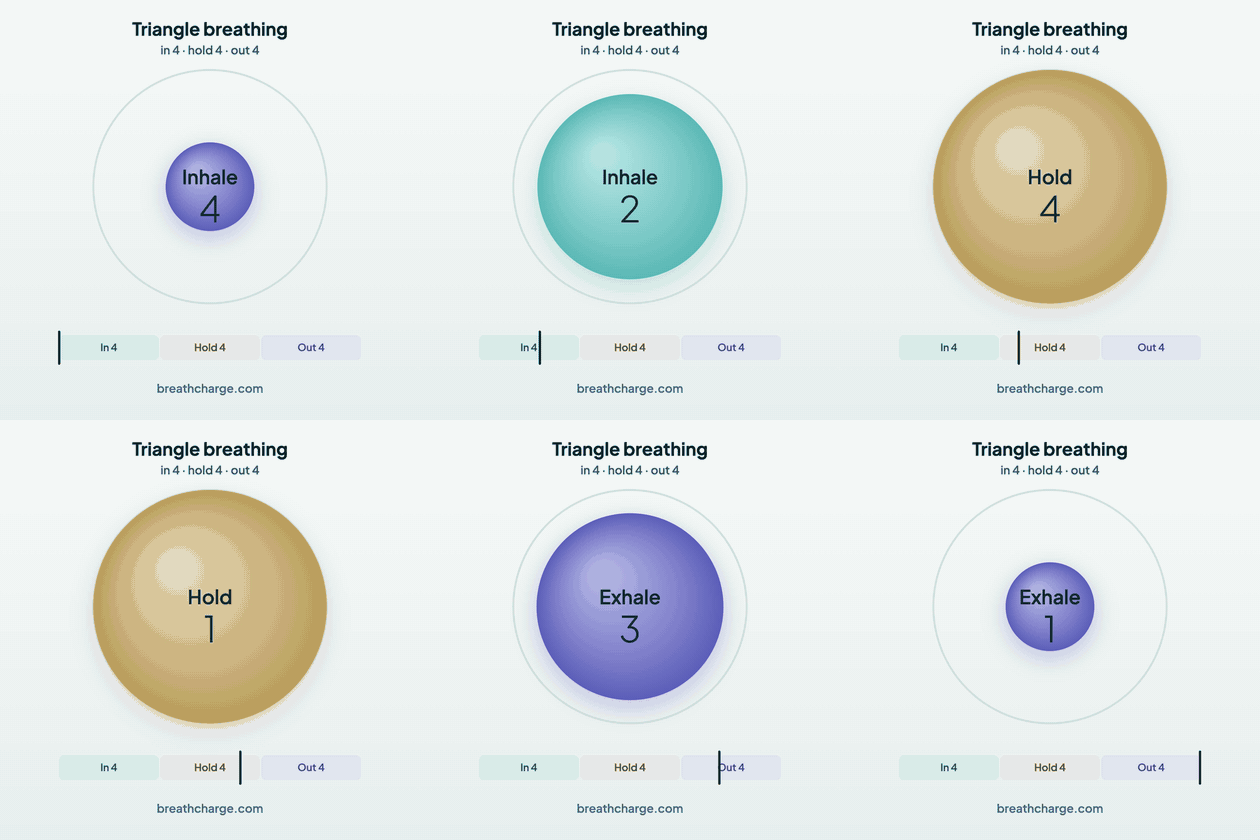
Free to use on websites, in classes and on social media under CC BY 4.0. Please credit with a link to this page:
<a href="https://breathcharge.com/triangle-breathing">Triangle breathing timer</a> by BreathchargeQuestions
What is triangle breathing?
A breathing pattern with three equal phases: inhale, hold and exhale, often 4 seconds each. It is like box breathing without the hold after the exhale.
What is the difference between triangle and box breathing?
Box breathing has four sides, including a hold with empty lungs. Triangle breathing drops that hold, so it is shorter and often feels easier.
How long should I do triangle breathing?
Three to five minutes is a good session. A few breaths before a stressful moment can also help.
Can I change the count?
Yes. Set each phase to any length, for example 3-3-3 to start or 5-5-5 for slower breathing, and save it as a preset.
Sources
- Balban MY, Neri E, Kogon MM, et al. (2023). Brief structured respiration practices enhance mood and reduce physiological arousal. Cell Reports Medicine 4(1):100895.
- Parkes MJ (2006). Breath-holding and its breakpoint. Experimental Physiology 91(1):1–15.
- Laborde S, Allen MS, Borges U, et al. (2022). Effects of voluntary slow breathing on heart rate and heart rate variability: a systematic review and a meta-analysis. Neuroscience & Biobehavioral Reviews 138:104711.
- Zaccaro A, Piarulli A, Laurino M, et al. (2018). How breath-control can change your life: a systematic review on psycho-physiological correlates of slow breathing. Frontiers in Human Neuroscience 12:353.