Long exhale · 4 in · 8 out
2-to-1 breathing timer
In 2-to-1 breathing, each exhale lasts twice as long as the inhale. The timer above uses 4 seconds in and 8 seconds out, five breaths a minute. It's one of the simplest ways to slow down and let go of tension, and it's the ratio at the heart of many relaxation practices.
Start 2-to-1 breathingHow to do 2-to-1 breathing
- Breathe in through your nose for 4 seconds.
- Breathe out for 8 seconds, slowly and evenly, as if fogging a mirror or through pursed lips.
- Don't squeeze. If you run out of air before 8, shorten both sides: 3 in, 6 out keeps the ratio.
- Continue for 3 to 10 minutes.
What happens in your body
More time on the slowing side. Your heart speeds up a little as you breathe in and slows as you breathe out, a normal rhythm called respiratory sinus arrhythmia. With a 2-to-1 ratio, two thirds of every breath is spent on the slowing side.
Inhale (and top-up)HoldExhale
What the studies show. In a 30-person experiment at six breaths a minute, a long exhale (about 30% in, 70% out, close to 2-to-1) felt more relaxing than a long inhale and raised a vagal marker of heart-rate variability more. A lab study of a stressful task found that prolonged-exhale breathing led to better performance than tactical breathing. These are small studies, so expect a gentle effect, not a switch.
Want the bigger picture? Read how breathing affects your body and mind: the heart, the nervous system, blood pressure and mood, with illustrations and 20+ studies.
Breathing safely
The slow patterns here are gentle, but holds and deep inhales can make you light-headed. Stop and breathe normally if you feel dizzy. Never practise breath holds in or near water, or while driving. If you are pregnant, or have a heart, lung or seizure condition or panic disorder, check with a clinician first. Breathing exercises can complement medical care but don't replace it.
Free 2-to-1 breathing GIF and video
Download GIF (1.4 MB) Download MP4 (0.2 MB)
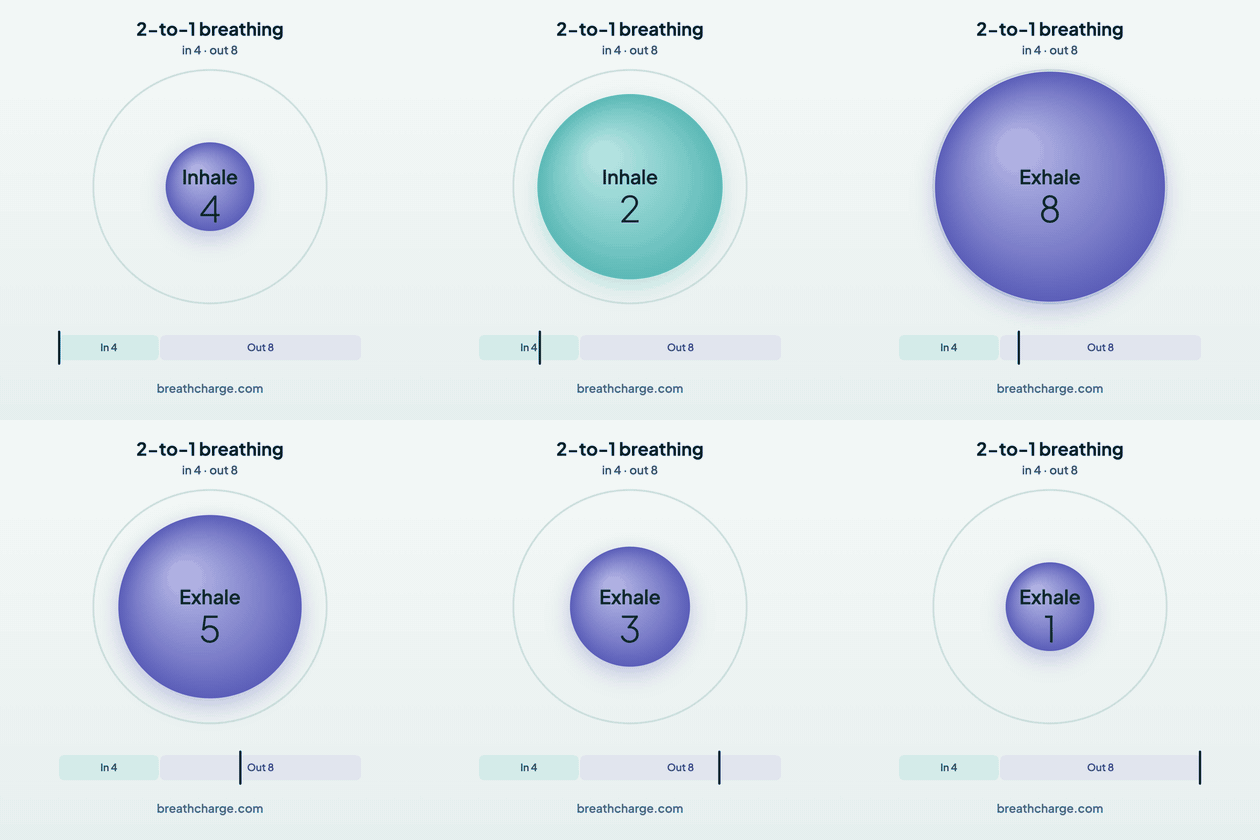
Free to use on websites, in classes and on social media under CC BY 4.0. Please credit with a link to this page:
<a href="https://breathcharge.com/2-to-1-breathing">2-to-1 breathing timer</a> by BreathchargeQuestions
What is 2-to-1 breathing?
A breathing pattern where the exhale lasts twice as long as the inhale, for example 4 seconds in and 8 seconds out.
Why is a longer exhale relaxing?
Heart rate naturally slows during each out-breath. Giving the exhale more time tips each breath towards slowing, and experiments show it feels more relaxing than an even or long-inhale breath.
What if I can't exhale for 8 seconds?
Keep the ratio and shorten both sides, for example 3 in and 6 out, or 2 in and 4 out. In Breathcharge, turn on "Keep the ratio" and change one number.
Is 2-to-1 breathing the same as 4-7-8?
Both have an exhale twice the inhale, but 4-7-8 adds a 7-second hold. 2-to-1 breathing has no holds, so many people find it easier.
Sources
- Van Diest I, Verstappen K, Aubert AE, et al. (2014). Inhalation/exhalation ratio modulates the effect of slow breathing on heart rate variability and relaxation. Applied Psychophysiology and Biofeedback 39(3–4):171–180.
- Röttger S, Theobald DA, Abendroth J, Jacobsen T (2021). The effectiveness of combat tactical breathing as compared with prolonged exhalation. Applied Psychophysiology and Biofeedback 46(1):19–28.
- Yasuma F, Hayano J (2004). Respiratory sinus arrhythmia: why does the heartbeat synchronize with respiratory rhythm? Chest 125(2):683–690.
- Laborde S, Allen MS, Borges U, et al. (2022). Effects of voluntary slow breathing on heart rate and heart rate variability: a systematic review and a meta-analysis. Neuroscience & Biobehavioral Reviews 138:104711.