Long exhale · 7 in · 11 out
7-11 breathing timer
7-11 breathing is a simple counting technique: breathe in for a count of 7, then out for a count of 11. The longer out-breath is what makes it calming. It's often suggested for anxiety and panic because it's easy to remember. The timer above uses seconds, 7 in and 11 out, about three breaths a minute.
Start 7-11 breathingHow to do 7-11 breathing
- Breathe in through your nose for 7, letting your belly expand.
- Breathe out through your mouth for 11, slowly and smoothly.
- Repeat for 3 to 5 minutes, or until you feel steadier.
Counts, not seconds. The original technique uses counts at whatever speed feels natural, and 7 real seconds in is a long breath for most people. If it feels like a strain, turn on Keep the ratio in Settings and set the inhale to 3.5: the exhale follows to 5.5.
What happens in your body
Slow and exhale-weighted. Heart rate dips a little with every out-breath, so an exhale that's longer than the inhale leans the whole breath towards calm. In a 30-person experiment, a long exhale felt more relaxing than slow breathing with a long inhale.
No direct trials yet. We couldn't find a peer-reviewed study of 7-11 breathing itself. The case for it rests on the wider research on slow, long-exhale breathing, which reliably shifts the body towards its calming "rest-and-digest" mode.
If you're anxious, keep it gentle. Big, forced breaths can blow off too much carbon dioxide and make you light-headed. A slow breath that's a little smaller is better than a deep one.
Want the bigger picture? Read how breathing affects your body and mind: the heart, the nervous system, blood pressure and mood, with illustrations and 20+ studies.
Breathing safely
The slow patterns here are gentle, but holds and deep inhales can make you light-headed. Stop and breathe normally if you feel dizzy. Never practise breath holds in or near water, or while driving. If you are pregnant, or have a heart, lung or seizure condition or panic disorder, check with a clinician first. Breathing exercises can complement medical care but don't replace it.
Free 7-11 breathing GIF and video
Download GIF (1.9 MB) Download MP4 (0.3 MB)
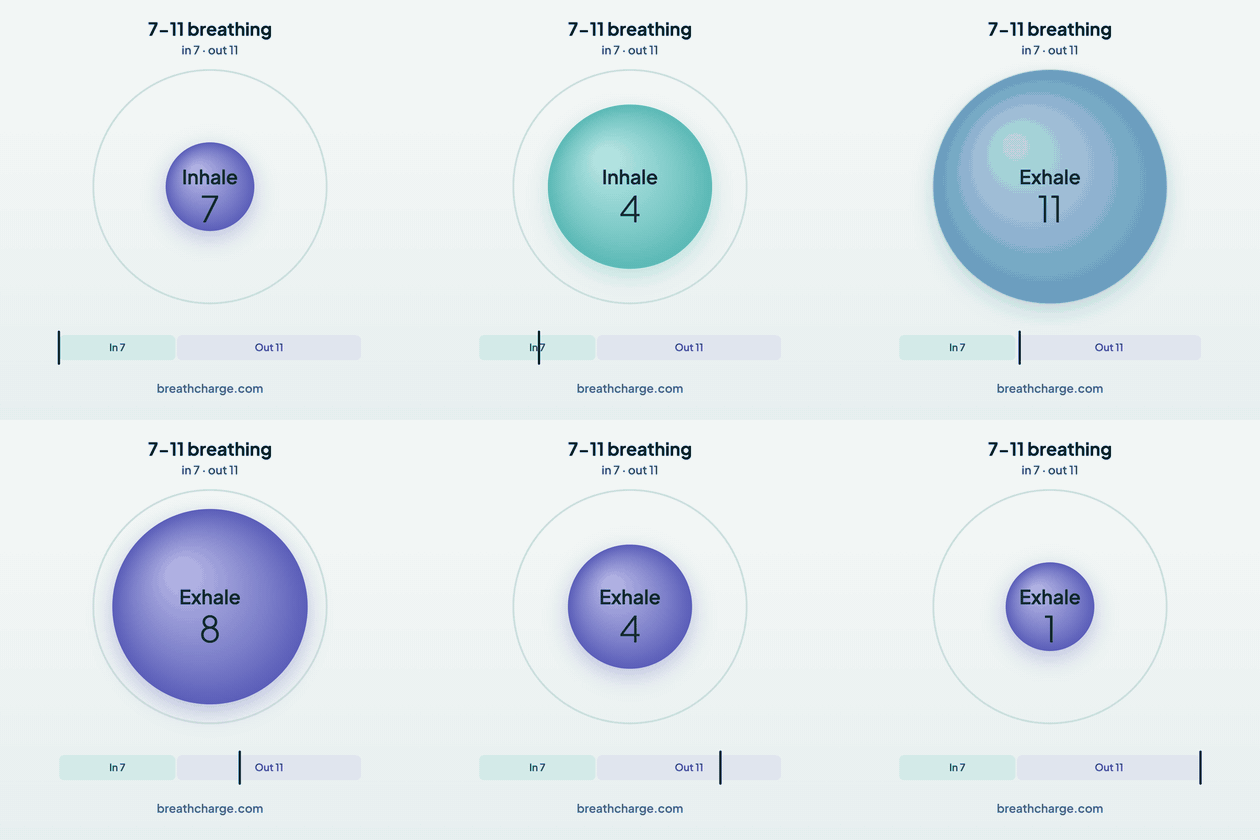
Free to use on websites, in classes and on social media under CC BY 4.0. Please credit with a link to this page:
<a href="https://breathcharge.com/7-11-breathing">7-11 breathing timer</a> by BreathchargeQuestions
What is 7-11 breathing?
A relaxation technique where you breathe in for a count of 7 and out for a count of 11. The longer exhale is what makes it calming.
Does 7-11 breathing help anxiety?
Many people find it settling, and long-exhale breathing in general is well supported as calming. There are no studies of the exact 7-11 count, so treat it as one useful option rather than a proven treatment.
Is 7 seconds too long to breathe in?
For many people it is. The original technique uses counts, which are often quicker than seconds. Scale it down, for example to 3.5 in and 5.5 out, and keep the exhale longer than the inhale.
How long should I do 7-11 breathing?
Three to five minutes is usually enough to feel a change. You can also do a few breaths whenever you notice tension.
Sources
- Van Diest I, Verstappen K, Aubert AE, et al. (2014). Inhalation/exhalation ratio modulates the effect of slow breathing on heart rate variability and relaxation. Applied Psychophysiology and Biofeedback 39(3–4):171–180.
- Laborde S, Allen MS, Borges U, et al. (2022). Effects of voluntary slow breathing on heart rate and heart rate variability: a systematic review and a meta-analysis. Neuroscience & Biobehavioral Reviews 138:104711.
- Zaccaro A, Piarulli A, Laurino M, et al. (2018). How breath-control can change your life: a systematic review on psycho-physiological correlates of slow breathing. Frontiers in Human Neuroscience 12:353.
- Meuret AE, Wilhelm FH, Ritz T, Roth WT (2008). Feedback of end-tidal pCO2 as a therapeutic approach for panic disorder. Journal of Psychiatric Research 42(7):560–568.