Extended exhale · 6 breaths per minute
4-6 breathing timer (extended exhale)
4-6 breathing means breathing in for 4 seconds and out for 6. It's smooth, has no holds, and lands at exactly six breaths a minute, the pace where heart and breath fall into step for most adults. It's Breathcharge's default Calm pattern, and the timer above is set to it.
Start 4-6 breathingHow to do 4-6 breathing
- Breathe in through your nose for 4 seconds, letting your belly rise.
- Breathe out slowly for 6 seconds, through your nose or softly through pursed lips.
- No pauses. Turn smoothly at the top and the bottom, following the orb.
- Keep going for 5 to 10 minutes, or six breaths for a one-minute reset.
What happens in your body
Two calming ingredients in one. Six breaths a minute is the rate used in most resonance-breathing research, where heart rate rises and falls in step with the breath. And the exhale is longer than the inhale. Your heart slows on every out-breath, so this leans each breath towards calm.
The ratio matters. In an experiment that tested exactly this, 30 people breathed at six breaths a minute with either a short or a long exhale. The long-exhale version felt more relaxing and raised a vagal marker of heart-rate variability more.
A 2022 meta-analysis of over 200 studies found that slow breathing like this reliably raises heart-rate variability during and after practice. Benefits for stress are real but modest, and a regular habit matters more than the exact count.
Want the bigger picture? Read how breathing affects your body and mind: the heart, the nervous system, blood pressure and mood, with illustrations and 20+ studies.
Make it yours in Breathcharge
If 4 seconds feels short, try 5 in and 7 out (5 breaths a minute). If 6 seconds out feels long, start at 3-5 and build up. With Keep the ratio on, changing one number scales the other.
Breathing safely
The slow patterns here are gentle, but holds and deep inhales can make you light-headed. Stop and breathe normally if you feel dizzy. Never practise breath holds in or near water, or while driving. If you are pregnant, or have a heart, lung or seizure condition or panic disorder, check with a clinician first. Breathing exercises can complement medical care but don't replace it.
Free 4-6 breathing GIF and video
Download GIF (1.2 MB) Download MP4 (0.2 MB)
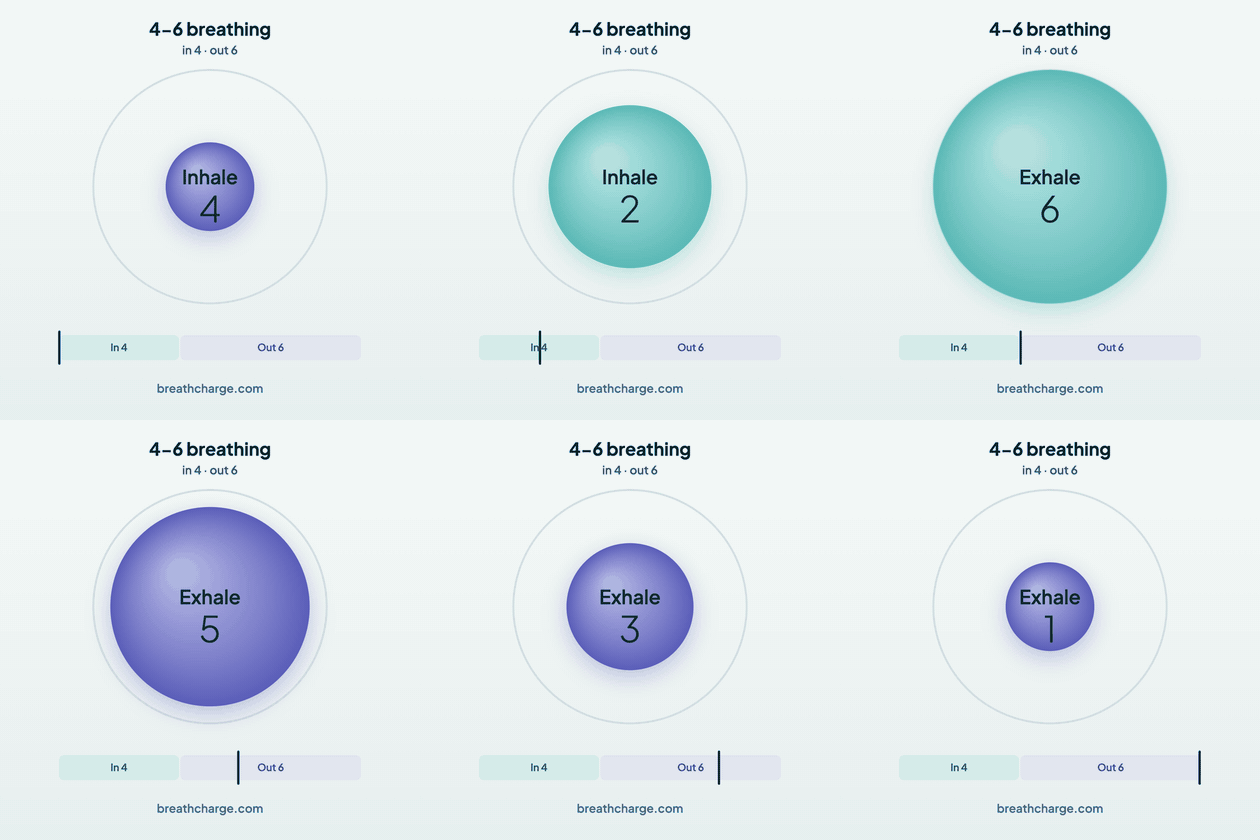
Free to use on websites, in classes and on social media under CC BY 4.0. Please credit with a link to this page:
<a href="https://breathcharge.com/4-6-breathing">4-6 breathing timer</a> by BreathchargeQuestions
What is 4-6 breathing?
Breathing in for 4 seconds and out for 6, with no holds. It gives six breaths a minute with a longer exhale, which is why it is often called extended-exhale breathing.
Is 4-6 breathing good for stress?
It combines the two best-studied ingredients of calming breathing: a slow pace of about six breaths a minute and a longer exhale. Studies show these shift the body towards rest, with modest benefits for stress over time.
Is 4-6 breathing the same as coherent breathing?
Close. Coherent breathing usually uses equal halves, like 5 in and 5 out, at a similar pace. 4-6 breathing keeps the same pace but gives the exhale more time.
How long should I do 4-6 breathing?
One minute (six breaths) as a quick reset, or five to ten minutes as a daily practice.
Sources
- Van Diest I, Verstappen K, Aubert AE, et al. (2014). Inhalation/exhalation ratio modulates the effect of slow breathing on heart rate variability and relaxation. Applied Psychophysiology and Biofeedback 39(3–4):171–180.
- Laborde S, Allen MS, Borges U, et al. (2022). Effects of voluntary slow breathing on heart rate and heart rate variability: a systematic review and a meta-analysis. Neuroscience & Biobehavioral Reviews 138:104711.
- Lehrer PM, Gevirtz R (2014). Heart rate variability biofeedback: how and why does it work? Frontiers in Psychology 5:756.
- Yasuma F, Hayano J (2004). Respiratory sinus arrhythmia: why does the heartbeat synchronize with respiratory rhythm? Chest 125(2):683–690.
- Fincham GW, Strauss C, Montero-Marin J, Cavanagh K (2023). Effect of breathwork on stress and mental health: a meta-analysis of randomised-controlled trials. Scientific Reports 13:432.